If you're a General Counsel, Chief Legal Officer, or Head of Legal Operations at a Series A– to PE-backed company evaluating Harvey AI vs. CoCounsel, you've likely realized that speeding up individual legal tasks doesn't eliminate contract delays.
Both tools accelerate discrete tasks: research, summaries, and document review, often reducing early-stage effort. On the surface, they appear similar. In practice, they address only part of the workflow.
Once AI output is generated, contracts still move through 5 to 7 disconnected tools (approval, negotiation, signature, and renewal). Each handoff compounds delay and risk, turning a simple renewal clause check into missed 30-day notice periods and avoidable 12% price increases.
That's the hidden cost of point-solution AI.
Aline takes a different approach by managing the entire contract lifecycle, from drafting and redlining to signing and renewal, in a single system.
"We were able to see renewal timelines and clauses across hundreds of contracts instantly. What used to be hours of searching now takes minutes." - Erin Zasada, Legal Counsel, Bison Transport.
The impact was clear with $30K in annual savings, 10+ hours reclaimed each week, and real-time visibility across tens of thousands of agreements.
$30K
Annual savings plus 10+ hours reclaimed each week after Bison Transport moved contract review into Aline.
Source: Erin Zasada, Legal Counsel, Bison Transport
For stakeholders managing 20-2,000 employees, this visibility delivers 5-10x faster contract cycles across pipelines covering 50 to 50,000 contracts, fewer manual handoffs, and clearer ownership across legal, sales, and finance.
This blog compares Harvey AI and CoCounsel side by side: what each tool is designed to do, where operational gaps appear, and why teams that want predictable outcomes increasingly choose Aline over standalone AI assistants.
Harvey AI is a generative AI platform built for legal professionals, designed to support core legal tasks through natural language processing. It launched in 2022 and quickly gained attention in the legal tech space due to its partnership with OpenAI and early adoption by major law firms.
The company positions itself as an AI legal assistant that helps lawyers work through research, drafting, and analysis more quickly, with a focus on compliance and controlled outputs.

Source: Harvey.ai
Lawyers often spend hours on repetitive research and analysis before they can even begin strategic work. In an enterprise case study, lawyers using Harvey AI reported saving 2–3 hours per week on routine tasks and reducing document review time by 30%, freeing up time for higher-value work.
Harvey provides a structured environment for asking legal questions, reviewing documents, and generating text that aligns with firm-specific guidelines.
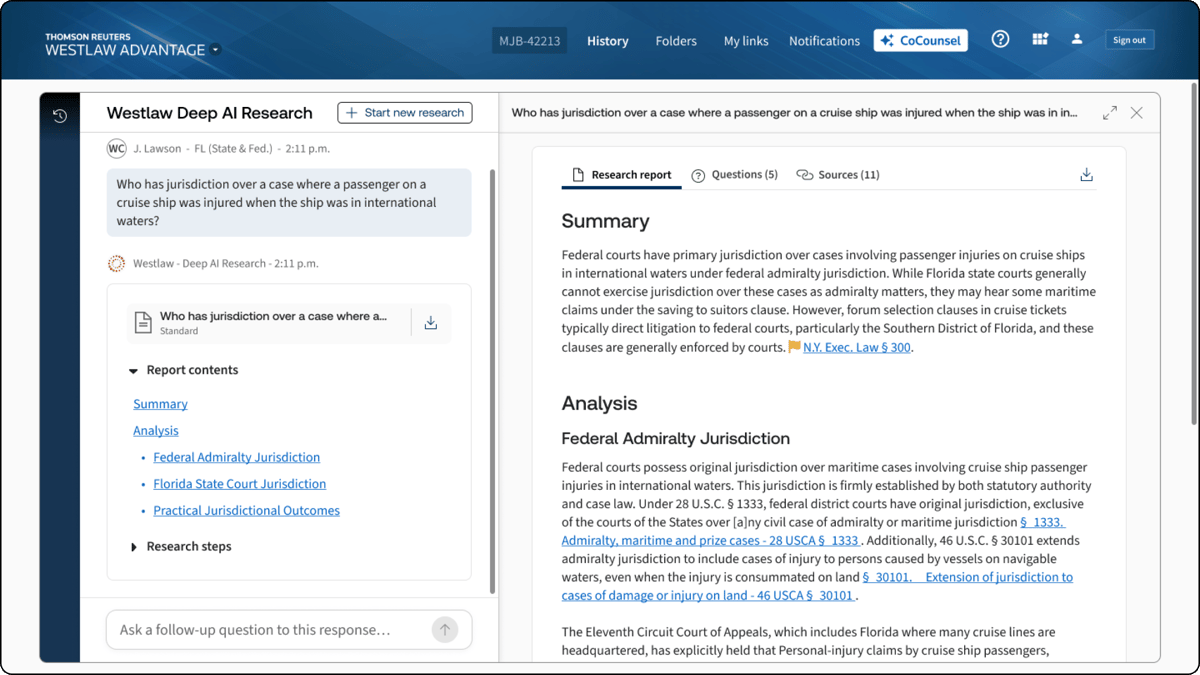
CoCounsel is an AI assistant built by Casetext (now part of Thomson Reuters) to help lawyers get through the kind of work that usually eats up hours.
It supports various legal tasks like reviewing long documents, checking contract language, answering research questions, and pulling details out of dense case materials.
Source: G2
What made it stand out early on was the way it was trained: human lawyers shaped the prompts, the workflows, and the guardrails. Through this technique, the tool feels built around real-world legal tasks rather than generic text generation.
It launched in 2023 and quickly picked up momentum across firms and legal departments that wanted a dependable way to tackle document analysis and routine legal processes more quickly.
CoCounsel is often described as a practical legal aide; something that reads, summarizes, and organizes information so human lawyers can stay focused on the judgment calls and strategy.
Aline is an AI-powered contract lifecycle management platform built for businesses and law firms that want a smoother way to handle every part of the contract process.
While other AI tools like Harvey and CoCounsel focus on narrower legal support, Aline covers the full contracting process (contract analysis, drafting, redlining, approvals, signatures, and long-term management) all in one system.
"The volume of paper crossing my desk was staggering; redlining a simple MNDA took up to 45 minutes of focused work. Now, I can do the same task in under two minutes," shares Daniel Telford, Sr. Director, Legal, Xevant.
MNDA redlining time
45 min
Manual review
<2 min
With Aline
Source: Daniel Telford, Sr. Director, Legal, Xevant
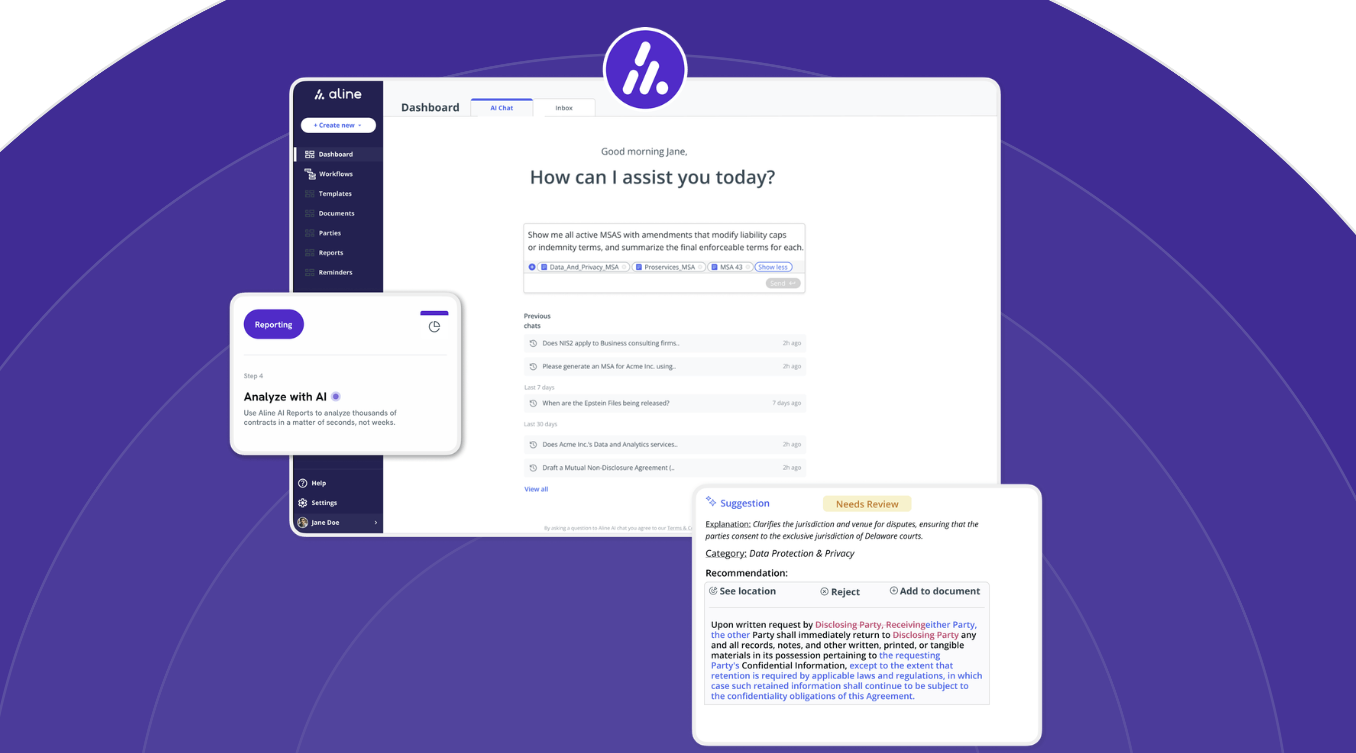
A big part of that experience comes from Aline's Legal Copilot. It helps teams research issues, review language, answer contract-related questions, and give the rest of the organization quick access to details that usually take time to track down.
The platform also includes AlineSign for built-in e-signatures, AI-driven workflows that move agreements through reviews and approvals, and AI reporting that pulls renewal dates, obligations, and risks without manual research.
Leading law firms, procurement teams, finance, sales, and legal ops rely on Aline because it replaces scattered tools and keeps everything connected, consistent, and easy to manage as contract volume grows.
Book a demo to see how Aline fits into your contract process.
| Platform | Primary Strength | AI Capability | Workflow Automation | Best Fit | Aline Differentiator |
|---|---|---|---|---|---|
| Aline | Full contract lifecycle management with AI-native workflows | Structured AI within playbooks | End-to-end (intake → draft → approve → sign → renew) | Scaling legal + revenue teams | Enforces legal standards before contracts enter negotiation. |
| Ironclad | Enterprise-grade CLM workflows | Add-on AI features | Strong but configuration-heavy | Large legal departments | Faster setup and lighter admin overhead. |
| DocuSign CLM | Contract execution + ecosystem integration | Limited drafting intelligence | Primarily signing-centric | DocuSign-centric enterprises | Handles drafting and review, not just execution. |
| ContractPodAi | CLM + AI assistant | Yes | Enterprise workflow engine | Mid-market to enterprise | Greater focus on speed-to-value and revenue impact. |
| Agiloft | Highly customizable CLM | Optional integrations | Highly configurable | Organizations needing deep customization | Less configuration burden, faster deployment. |
Move beyond task-level AI
Aline lets you redline and negotiate agreements up to 50% faster with its AI capabilities. Try Aline for free and see how predictable contract workflows can be.
Sorting through Harvey AI, CoCounsel, and Aline all sit under the legal tech umbrella, but they solve very different problems.
Here's a quick breakdown to help you see where each one fits and which direction makes the most sense for your workflow.
Harvey AI and CoCounsel are task-level generative AI tools within the legal workflow, with their scope limited to specific functions. The following is what each platform handles, where that coverage stops, and how Aline addresses it.
Harvey AI is optimized for research-heavy, analysis-driven workflows, including due diligence, legal reasoning capabilities, and synthesizing large volumes of legal text. Its value is in accelerating cognitive work that would otherwise require significant manual effort.
What it does not do is:
This means that timeline predictability depends on downstream execution workflows and manual coordination rather than on Harvey AI itself.
CoCounsel focuses on repeatable, well-defined legal tasks such as document review, contract checking, and research queries.
What it does not do is:
This means CoCounsel improves task reliability, but execution still fragments once work needs to move across teams or stages.
Aline is built around the problem the others leave unsolved: owning the entire contract lifecycle.
Instead of optimizing isolated tasks, Aline brings drafting, redlining, approvals, signing, and renewals into a single workflow so work doesn't stall once the AI step is finished.
Here is how it closes the loop:
| What's Missing | How Aline Covers It |
|---|---|
| No approval routing or ownership | Dynamic approval workflows assign owners and SLA timelines automatically. |
| No execution or signing layer | Native e-signatures through AlineSign eliminate external handoffs. |
| No end-to-end lifecycle visibility | Single draft-to-renew workflow keeps contracts centralized. |
| No structured contract metadata | Automated metadata extraction pulls key clauses and dates instantly. |
| Timeline predictability depends on external tools | Drafting, approvals, signing, and renewals live inside one system. |
| No lifecycle-level audit posture | Continuous audit logs capture every contract action. |
All this operational visibility is what teams consistently point to as the difference:
"Everything's backed up in Aline. If we ever need it, we can pull it up instantly, signed, dated, and stored securely." - Christina Varela, Paralegal, Jushi.
With Aline, teams reduce 20% of legal reporting time and cut up to 30 hours spent on sales contracts. Request a demo to see the impact.
Choosing between Harvey AI, CoCounsel, and Aline gets easier once you look at what each platform actually does best. Let's take a look at the standout features that shape how these tools fit into real legal work.
| Capability Area | What This Means in Practice | Why It Matters for Legal Ops |
|---|---|---|
| System role | Acts as the contract system of record, not an overlay tool. | Contract state and ownership available end-to-end. |
| Lifecycle continuity | Contracts stay in one workflow from draft to renewal. | Fewer lifecycle breaks and renewal risk. |
| Data reusability | Extracted clauses, dates, and obligations reused across workflows. | No duplicate analysis or manual re-entry. |
| Configuration ownership | Templates, workflows, and reports configurable by legal teams. | Faster iteration, less vendor dependency. |
| Audit posture | Continuous, traceable audit trails across all contract actions. | Audit-ready without manual reconstruction. |
| AI containment | AI constrained by approved playbooks. | Lower risk from inconsistent outputs. |
| Tool consolidation impact | Consolidates AI, CLM, e-sign, and reporting. | Simpler stack, lower operational overhead. |
See how Aline scales beyond point solutions, processing 10,742 agreements in under 4 minutes. Explore Aline with a free trial.
10,742
Agreements processed in under 4 minutes
Aline platform benchmark
50-75%
Faster contract redlines using standardized playbooks
Aline AI vs. manual review
90%
Less manual reporting effort with AI-structured fields
Aline AI reporting
Harvey AI is a strong fit for associates and research attorneys handling research-intensive work, particularly in firms that regularly analyze large volumes of case law and legal documents.
Teams that want a fast generative AI assistant for drafting, summarizing, and early analysis tend to get the most value here. It works well for groups that already use multiple legal AI tools at once and want something that plugs into their existing research workflow.
CoCounsel fits mid-market firms and larger firms that need predictable, structured support for tasks like document review, research checks, and deposition prep.
It's especially useful for teams that want AI to handle routine legal work with consistency. Firms that rely on dependable workflows rather than customization usually prefer CoCounsel's approach.
Aline is ideal for organizations that want more than point AI solutions, especially legal, sales, finance, procurement, and operations teams that work with a high volume of contracts.
Aline supports small legal teams, mid-sized firms, and large organizations that rely on contract analysis at scale by accelerating review and execution. Aline AI can redline agreements 5–10× faster than manual review and analyze 10,000+ contracts in seconds, helping teams pull deals forward, prevent missed renewals, and maintain confidence that obligations and revenue-critical terms are fully tracked.
Aline is also a strong fit for teams replacing siloed tools and aiming to centralize their entire contract lifecycle.
Sorting out pricing helps clarify which tool fits your team's budget and setup. Here's a quick look at what each platform offers and what you can expect.
Pricing is not publicly available. Harvey doesn't list plan details or seat-based pricing on its site.
Pricing is also not publicly available. Since CoCounsel operates under Thomson Reuters, costs vary by firm size, usage needs, and bundled products in the TR ecosystem.
Aline provides transparent pricing with both a team plan and an enterprise option.
Check out Aline's pricing plans to see which option fits your team best.
Harvey AI and CoCounsel each bring useful AI support to specific parts of legal work, but Aline delivers something broader: a cutting-edge platform built to run the entire contract lifecycle in one place.

Its advanced features cover AI contract drafting, redlining, analysis, approvals, signing, and reporting, giving teams a single system that grows with them rather than another tool to juggle.
There's also far less of a learning curve since Aline connects the AI layer with the actual workflows legal and business teams use every day. Instead of stitching together deep research tools, contract editors, signature apps, and reporting dashboards, everything lives inside one unified platform.
If delayed contracts, missed renewals, or unclear ownership can push revenue out of a quarter or expose you to avoidable risk, Aline centralizes every clause, approval, signature, and renewal date, so execution stays predictable and nothing critical slips through.
If renewal dates, obligations, and approvals aren't XX% more visible and predictable, cancel, no lock-in.
Harvey AI is generally accurate for research, drafting support, and early document review, but its output still depends on clear prompts and human oversight. It uses large language models to speed up legal analysis, though lawyers should validate anything tied to real decisions.
CoCounsel is used by a mix of mid-sized firms and larger firms, including several well-known practices that already rely on Thomson Reuters tools. Adoption continues to grow as CoCounsel becomes more integrated into TR's legal ecosystem.
AI tools collectively surpassed early expectations in document analysis, but each one approaches it differently. CoCounsel focuses on structured, repeatable checks, while Harvey offers flexible LLM-driven review. Key takeaways often depend on the type of document, the prompt, and how much human expertise shapes the workflow.
Harvey gives power users a flexible environment built on a lawyer baseline, making it useful for teams that want generative Artificial Intelligence tools to adapt to complex review patterns. CoCounsel focuses on the seven core legal tasks with a more structured workflow, which helps firms that prefer predictable outputs in their legal tools. Aline takes a different path by incorporating AI directly into the contract lifecycle, combining phases like contract review and document summarization with the operational steps teams rely on every day.
Harvey assistant works best for research-heavy assignments, quick summaries, and spotting issues in long documents. It's helpful when lawyers need fast takeaways without manually reading large volumes of text.
Harvey can struggle with niche areas, unusual drafting styles, or documents that fall outside its training patterns. It's strong for broad legal work, but it still requires human review to ensure accuracy and context.