If you’ve used Spellbook, you already know the appeal. Contract reviews move faster, risky clauses are flagged earlier, and legal teams spend less time combing through repetitive language.
But speed at the review stage often reveals a different problem: once edits are finished, agreements still wait in inboxes for approvals, negotiation cycles, or signatures that slow progress.
This is especially true for in-house counsel, legal operations leaders, procurement teams, and revenue-driven SaaS companies where contracts don’t stop at redlining. Deals depend on how quickly documents move across sales, finance, and leadership (not just how fast legal can analyze risk).
Industry benchmarks reflect this gap: 56% of legal teams still need a week or more to close standard agreements like NDAs, reflecting the downstream workflow friction that continues to slow execution.
At lower volumes, these delays can be a minor slowdown. But as organizations scale, agreements can still take an average of 43 days to move from creation to signature, with approval routing and signing remaining the longest stages, even as review itself accelerates.
Legal operations leaders see this pattern play out daily:
“When routine NDAs take weeks to complete, that’s revenue sitting on the table. Organizations can’t afford to have their growth constrained by manual contract processes.” - Shashank Bijapur, CEO and co-founder, SpotDraft.
That’s often the point when teams begin evaluating Spellbook alternatives. Many solutions focus on improving drafting or AI-assisted review, but organizations quickly realize that optimizing a single stage of the workflow doesn’t always remove operational friction across the full contract lifecycle.
Platforms like Aline approach the problem differently, bringing drafting, redlining, approvals, execution, and renewal into a unified workflow rather than adding another layer to the review process.
In this guide, we compare the strongest Spellbook alternatives through the broader lifecycle lens, highlighting where each platform fits and why teams moving beyond review-only tools often look for solutions like Aline that support speed, governance, and measurable outcomes across the entire contracting process
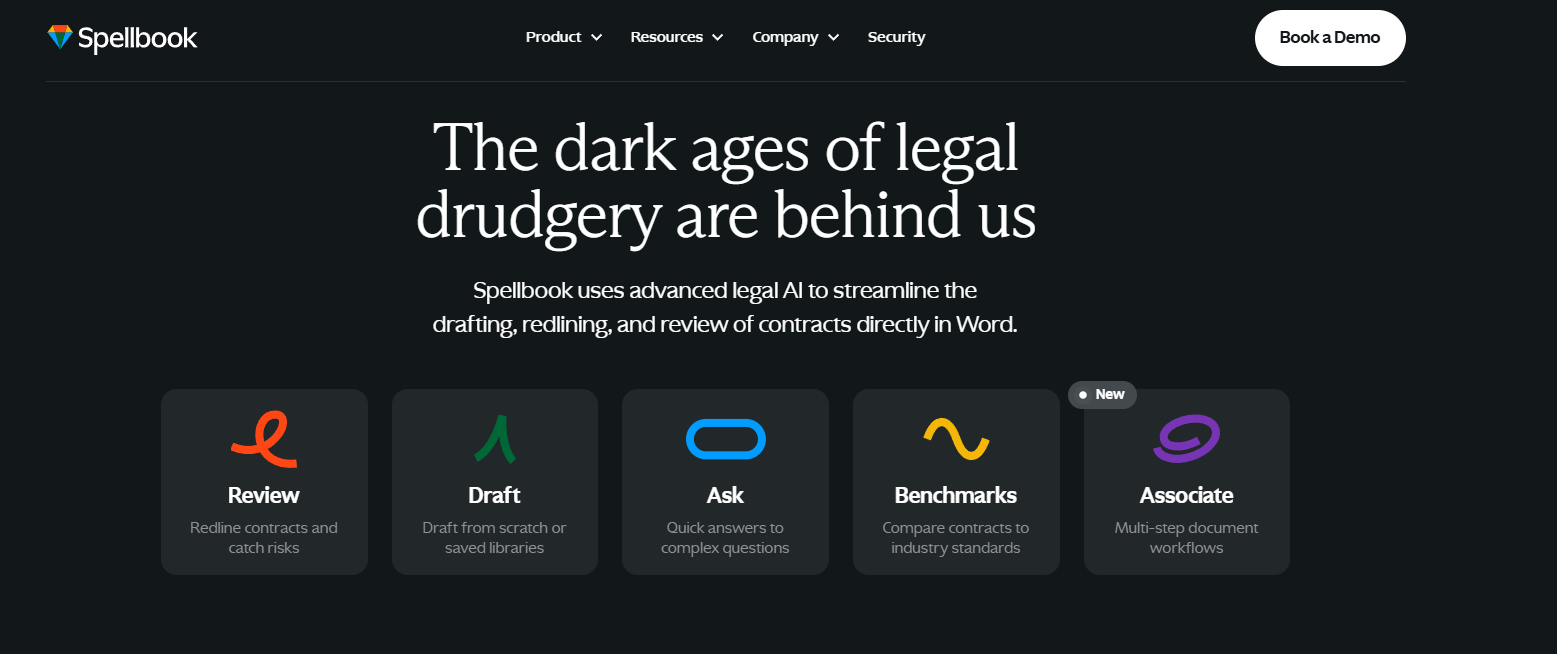
Spellbook is an artificial intelligence (AI) tool that helps make contract review a little less tedious. Instead of reading through every contract yourself, Spellbook scans the document, highlighting key clauses, potential risks, and other important details.
Source: Spellbook.Legal
Basically, it’s designed to save you time by pointing out what you need to focus on so you don’t have to go through everything manually.
That said, while it’s handy for speeding up the process, it’s not flawless. Like any legal AI tool, it has its limits and might miss something, depending on the contracts and how it’s trained. But for teams handling a lot of contracts, it can definitely make the job easier.
Even though tools like Spellbook improve drafting and redlining speed, relying on a single AI contract assistant can expose operational blind spots, especially as legal teams move from experimentation to scaled AI adoption.
AI acceleration doesn’t solve process fragmentation: 60% of legal teams still lack structured contract playbooks, creating inconsistencies that AI plugins alone can’t standardize across departments. Spellbook’s Word-centric approach works well for individual drafting but may leave gaps in lifecycle governance, reporting, or collaboration layers that exist outside the document editor.
Efficiency gains plateau without deeper integrations: AI tools reduce review time by 40–60% and help detect 30% more hidden risks, but these gains rely on integrated analytics, risk tracking, and knowledge management workflows. Teams using only drafting assistants often struggle to measure ROI because benchmarking and analytics aren’t embedded into broader legal operations.
AI adoption is rising faster than tooling maturity: Contract-review AI usage grew 75% year-over-year, yet only 14% of teams currently use it, indicating early-stage experimentation rather than full workflow transformation. This gap suggests that many teams begin with tools like Spellbook but later look for platforms that extend into approvals, compliance monitoring, or contract data insights.
Accuracy and risk oversight still require layered tooling: AI contract tools can achieve 94% accuracy vs. the human average of 85%, but hallucination risks and governance requirements remain top concerns for legal leaders. Without centralized audit trails or approval workflows, teams may struggle to operationalize AI outputs safely at scale.
As AI adoption matures, legal teams increasingly evaluate whether point solutions meet broader operational requirements. Industry benchmarks reveal several triggers behind the search for alternatives or complementary platforms.
Scaling beyond drafting to full contract lifecycle management: Legal teams reviewing 500 contracts annually spend up to 188 working days on review tasks, showing the requirement for workflow automation beyond drafting suggestions. Platforms that include approvals, clause analytics, or compliance reporting often become necessary as contract volumes grow.
Aline is an AI-powered contract lifecycle management (CLM) platform built for in-house legal teams, legal ops leaders, procurement stakeholders, and finance teams looking to simplify complex contracting processes and keep agreements moving across departments.
While many AI tools focus on contract analysis alone, Aline keeps drafting, approvals, signing, and tracking inside one continuous workflow, helping reduce tool handoffs and move agreements from review to execution faster. This, in turn, shortens deal cycles by up to 24–40% and improves revenue predictability through structured lifecycle management.

With AI-assisted contract drafting, automated workflows, dynamic templates, and built-in compliance checks, Aline helps legal, sales, and finance teams review contracts up to 10X faster by combining AI-assisted redlining with shared playbooks, with users reporting that the time taken for MNDA redlining dropped from about 45 minutes of manual work to under 2 minutes.
The platform uses AI to analyze thousands of contracts in real time to pull critical business and legal information.
Its no-code template builder, e-signature functionality, and reporting tools give companies the flexibility to manage contracts efficiently while staying compliant.
What’s different with Aline isn’t feature depth, but lifecycle ownership. By keeping drafting, approvals, and execution in a single workflow, the platform eliminates cross-tool handoffs that often stall agreements after review.
Aline and Spellbook both use AI to improve contract management, but they focus on different aspects of the process.
Spellbook is designed primarily for AI-assisted contract drafting and review, which helps legal teams analyze contracts and identify risks more efficiently.
Aline, on the other hand, is a full contract lifecycle management platform that offers tools for drafting, negotiating, signing, and managing contracts in one place.
While Spellbook primarily improves contract review and revisions, Aline extends automation across drafting, approvals, execution, and reporting from a centralized workflow.
By reducing the need to move contracts between separate tools, teams can shorten turnaround times by 40% and keep agreements progressing without manual follow-ups.
As a contract management solution, Aline is often better suited for general counsel and legal operations teams managing both compliance responsibilities and operational timelines, where contracts must move quickly from review into approval and signature.
See how agreements flow from drafting → negotiation → execution in a single lifecycle workflow. Start your free trial today!
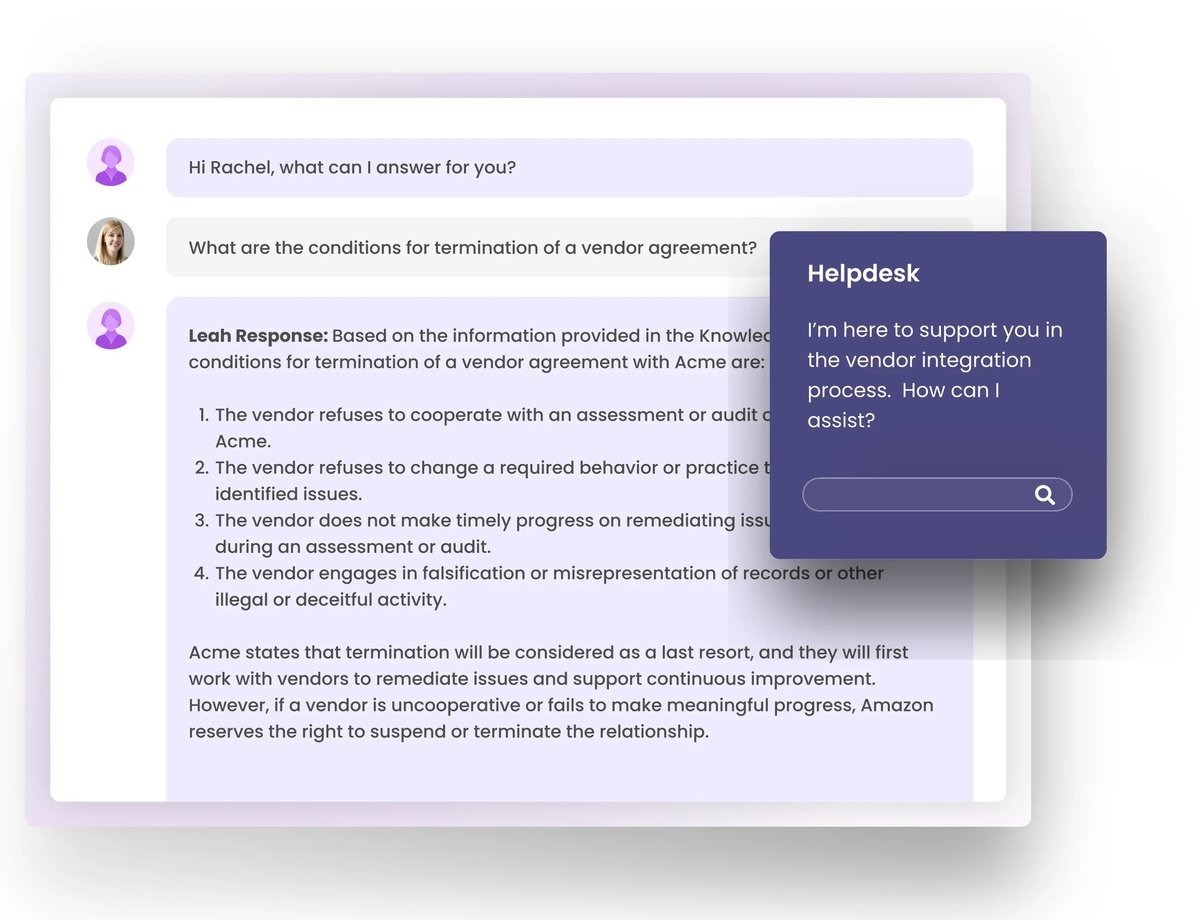
Leah, formerly known as ContractPodAi, is a contract management platform that uses AI to help teams keep contracts moving without losing track of details along the way.
It’s built for organizations handling a steady stream of agreements and looking for a more reliable way to manage everything beyond the initial review.
Source: G2
Legal, procurement, and sales teams use Leah when contracts pass through multiple hands and systems. Drafts, approvals, signatures, and stored agreements all live in one place, which cuts down on back-and-forth and manual follow-ups.
Spellbook is focused on helping you review and revise contract language faster. Leah picks up once that review is done.
Rather than stopping at clause analysis, Leah supports the steps that follow, including approvals, signatures, and ongoing contract tracking. It makes more sense for teams that want fewer handoffs between tools and clearer visibility into what’s happening after review.
Luminance is an AI-powered contract review and analysis platform used by legal teams that handle large volumes of documents and need to spot risks quickly. It’s especially common in big law firms, where reviewing contracts at scale is part of everyday work.

Source: Luminance.com
Rather than treating each contract as a one-off, Luminance looks for patterns across documents. Its machine learning models analyze language, flag inconsistencies, and surface compliance issues.
This capability makes it useful for due diligence, audits, and other large document reviews where speed and consistency matter the most.
Luminance and Spellbook both use AI for contract review, but their approaches are different.
Spellbook is designed for drafting and revising contracts, using AI to suggest edits and improve contract language, while Luminance specializes in contract analysis, risk detection, and large-scale document reviews.
Luminance is a better fit for teams handling due diligence, audits, and regulatory compliance, as it focuses on flagging risks and inconsistencies across multiple contracts at once.
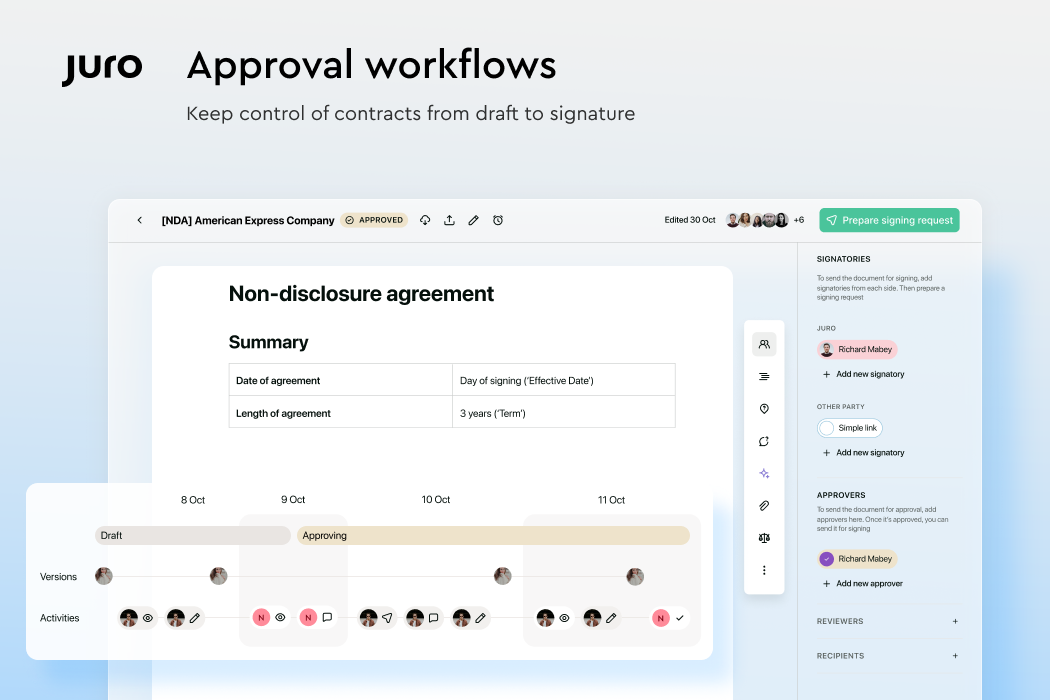
Juro is an AI-powered contract automation platform built for businesses that need a fast, collaborative way to create, approve, and sign contracts.
With a strong focus on automation and real-time collaboration, Juro is widely used by legal, sales, and HR teams to handle high-volume contracts like NDAs, MSAs, and employment agreements.
Source: G2
While Spellbook is best for teams that need AI-assisted contract analysis, Juro is a better fit for businesses looking for an all-in-one contract management tool.
It’s particularly useful for sales and HR teams that need to generate and process contracts quickly while keeping everything in a single, searchable database.
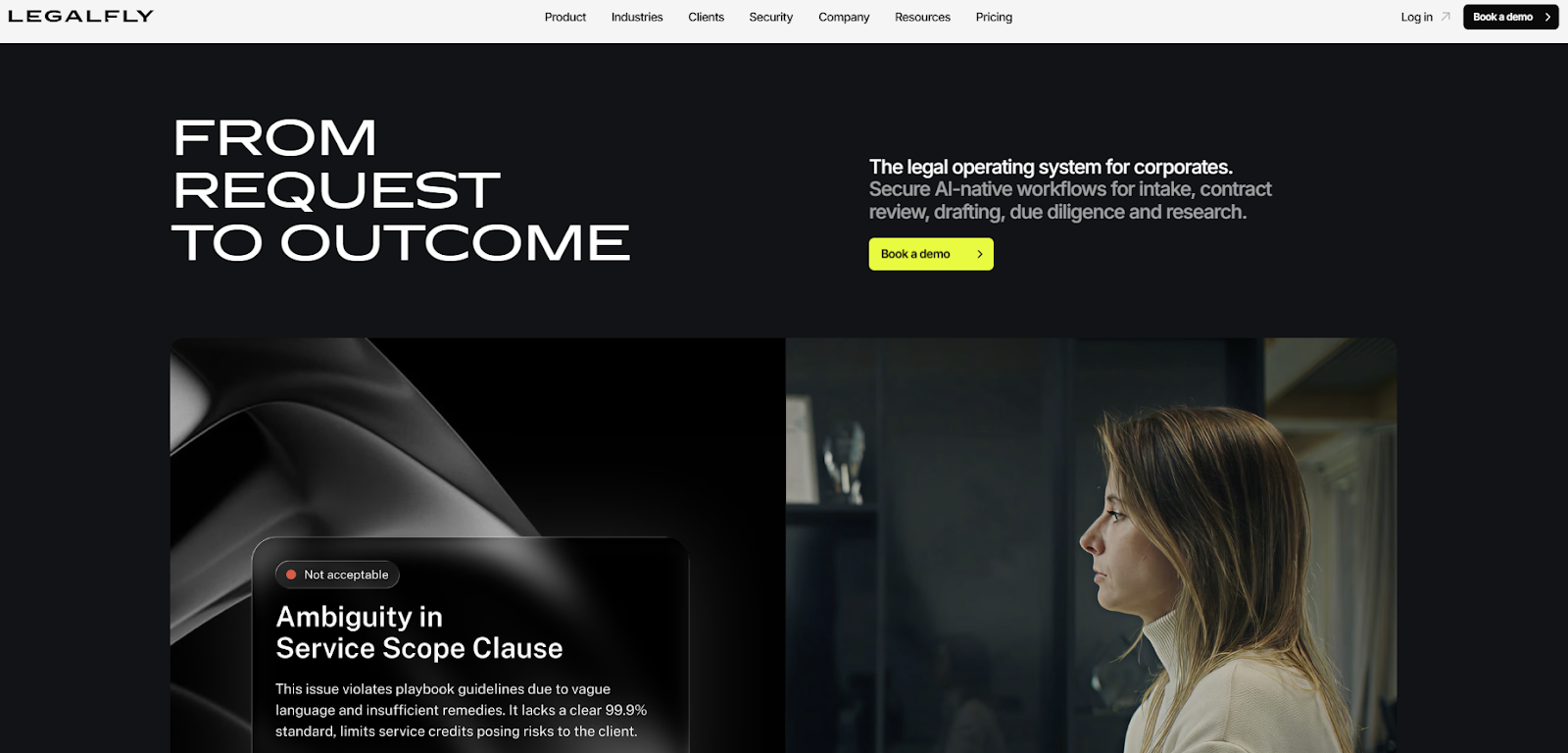
LegalFly is an AI-powered legal assistant designed to help legal teams draft, review, and manage contracts more efficiently.
It offers a range of features aimed at streamlining legal workflows and ensuring compliance, which makes it a good choice for in-house legal departments and law firms.
Source: LegalFly.com
Spellbook focuses on AI-assisted contract review and risk detection. LegalFly offers a broader suite of tools, including document discovery, anonymization, and deep integration with Microsoft Word.
LegalFly also emphasizes data privacy by anonymizing sensitive information before processing, a feature not prominently highlighted in Spellbook.
Choosing the right Spellbook alternative comes down to how far you want contract work to go beyond review.
For some teams, identifying clauses and risks is where the process ends. But for growing organizations, contracts often slow down after review, get stuck in approval queues, create uncertainty around timelines, or only come back into focus when renewal dates or obligations approach.
What teams typically see after moving beyond review-only tools:
Aline is built for that full arc. Drafting, revisions, approvals, signatures, and ongoing visibility all live in one system. Aline's workflows make sure that contracts don’t stall once review wraps up.
Plus, AI supports the work where it makes sense, while workflows, templates, and reporting keep everything organized as volume grows.

Before you know it, things start to feel easier. You’re not bouncing between tools or piecing together updates from different systems. Contracts remain centralized and move forward with fewer manual follow-ups, helping legal, sales, and finance stay aligned with shared visibility into progress, ownership, and post-signature obligations.
Ready to move contracts past approval delays and into execution?
Experience a lifecycle workflow that moves agreements from redlining to signature with shared team visibility.
See how Aline works in practice with a guided walkthrough tailored to one of your real agreements.
What is the alternative to Spellbook?
There are several alternatives to Spellbook, depending on what you need. Aline is a great choice for businesses looking for a full contract lifecycle management platform with AI-powered contract review, workflow automation, and built-in e-signatures that help optimize everyday legal work across teams.
What is the difference between Spellbook and ChatGPT?
Spellbook is an AI contract review tool designed to analyze contracts, flag risks, and suggest edits for legal teams. ChatGPT, on the other hand, is a general-purpose AI chatbot that can assist with various tasks, including answering legal questions, drafting text, and brainstorming ideas. Spellbook is built specifically for contract analysis, while ChatGPT is a broader AI tool that doesn’t specialize in legal workflows.
How can legal professionals save time with a Spellbook alternative?
Legal professionals can save time by using AI-powered contract management tools like Aline, which automates contract review, drafting, and approvals. Instead of manually reviewing every page, Aline’s AI quickly analyzes contracts, highlights key clauses, and ensures compliance, reducing the time spent on legal research and revisions.
Does using a Spellbook alternative reduce costs?
Yes, switching to a comprehensive contract management platform can help cut costs by reducing manual work, improving efficiency, and minimizing legal risks. Tools like Aline eliminate the need for multiple software subscriptions by combining AI review, workflow automation, and e-signatures in one platform, making it a cost-effective solution for handling contracts post-review.