Category:

9 Best Icertis Competitors for Modern Contract Teams

This is some text inside of a div block.

By:

Brent Farese

,

April 6, 2026

If you’re an in-house legal counsel at a growing startup, a founder who still handles contracts manually, or a legal operations manager at a scaling mid-market company, contract management often starts out simple..

A few agreements are drafted in Word, revisions happen over email, approvals are chased on Slack, and signatures go through DocuSign. Contracts are eventually stored in Google Drive or SharePoint, with renewal dates tracked in a spreadsheet.

For a while, that system works.

In fact, many teams still operate this way. 49% of legal teams manage contracts using Word documents, email, and shared folders.

But it works only until contract volume grows.

Suddenly, sales teams are waiting on legal edits, procurement agreements take days to locate, and no one is entirely sure which version of a contract is final. Even reviewing contracts is time-consuming, with in-house lawyers spending around 3.1 hours on a single contract.

This is usually when teams begin exploring contract lifecycle management (CLM) platforms like Icertis.

Icertis is one of the most well-known enterprise CLM platforms. It handles large, complex agreements across procurement, legal, and sales teams, and it offers deep workflow automation, compliance tracking, and analytics. 

But the platform is also built with large enterprise deployments in mind, which often means longer implementation timelines, higher costs, and significant configuration effort.

For many growing companies, that level of complexity simply isn’t necessary.

Instead, they want tools that can replace the patchwork contract workflow they already use: drafting, approvals, signatures, storage, and renewal tracking, without requiring months of implementation or a dedicated legal tech team to manage the system.

That’s where newer CLM platforms are worth evaluating.

To make your search easier, we did the heavy lifting and identified the top 9 Icertis alternatives with simpler workflows and better collaboration among legal, sales, and procurement teams, while still providing the automation and visibility needed to manage contracts at scale. 

What Is Icertis? And Why Do Teams Outgrow It?

Icertis is an enterprise contract lifecycle management (CLM) platform built to handle the entire contract process: from drafting and negotiation to approvals, compliance, and renewals.

At the core of the platform is Icertis Contract Intelligence (ICI), which centralizes contract data, automates workflows, and uses AI to flag risks and unusual terms in agreements.

Icertis is designed for organizations managing large contract volumes across global teams. But that same enterprise depth is also why some teams eventually start looking for alternatives.
Source

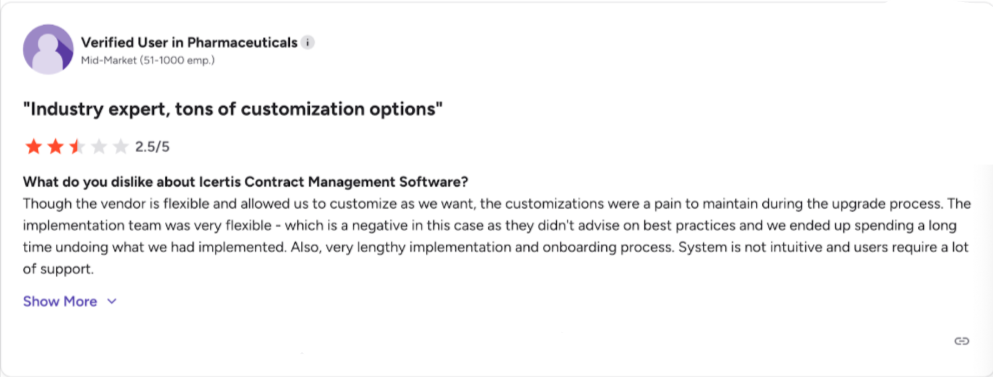
Based on multiple user reviews, some of the most common challenges teams mention are:

  • Implementation can run up to 6 months before a single contract moves through the system, with ROI often stretching to 22 months.
  • High licensing and customization costs, which can become difficult for mid-market teams to justify.
  • Heavy configuration requirements when adapting the system to new workflows.
  • Usability challenges where legal or sales teams need additional support to navigate the interface day-to-day.
  • Not cost-effective for smaller organizations with limited budgets and simpler requirements.

These drawbacks don’t mean the platform is flawed. It’s built for multinational enterprises with dedicated legal tech teams that can support implementation cycles of up to 6 months. If that isn’t your setup, you’re likely outside the ICP it was designed for.

For teams without that infrastructure, the challenges tend to become more noticeable as contract volume grows.

And that matters because contracts are rarely handled by just one department. 29% of a company’s workforce interacts with contracts in some way, across legal, procurement, finance, and sales.

So when the CLM platform becomes difficult to manage, the friction doesn’t stay in legal. It spreads across the entire revenue and procurement workflow, which is often when teams begin looking for simpler or faster-to-deploy Icertis alternatives.

What Should You Look for in an Icertis Alternative?

If Icertis starts to feel too complex or resource-heavy, the next step is evaluating alternatives that better fit your team’s workflow.

Here are the key capabilities to look for when choosing an Icertis alternative.

What to Look for in a Juro Alternative

Faster implementation
Complex CLM rollouts can take months. Tools that deploy quickly help teams start managing contracts sooner and avoid long IT projects.
Intuitive contract workflows
If the platform is hard to navigate, adoption drops. Legal, sales, and operations teams need workflows that are easy to understand and use daily.
Lower configuration overhead
Platforms that require extensive customization often demand ongoing administrative work. Simpler configuration reduces setup time and maintenance.
Strong integrations with existing tools
Contract workflows often depend on CRM, procurement, storage, and communication systems. Integrations keep contracts connected to the rest of the business process.
Built-in AI for review and risk detection
Modern CLM platforms use AI to automatically detect risky clauses, summarize agreements, and accelerate contract review workflows.
Scalable pricing
Enterprise CLM systems can become expensive as usage grows. Pricing that scales predictably helps teams expand contract operations without unexpected cost spikes.

Top Icertis Alternatives to Consider in 2026 (Evaluated by Contract Automation, Integrations, and Ease of Use)

Tool Core Focus AI Capabilities Workflow Automation Typical Users Best Icertis Alternative If…
Aline AI-first contract lifecycle automation AI drafting, redlining, clause insights End-to-end lifecycle automation Legal, RevOps, and revenue teams You want an AI-first CLM that replaces Word, DocuSign, and manual contract workflows.
DocuSign CLM Enterprise contract management Contract analytics Structured enterprise workflows Enterprise legal departments Your company already relies heavily on DocuSign and needs structured contract workflows.
Agiloft Highly customizable enterprise CLM Contract analytics and clause extraction Highly configurable workflows Large enterprises You need a highly configurable CLM platform with deep customization.
Conga CLM Salesforce-based contract lifecycle management Contract insights Salesforce-driven workflows Salesforce-centric organizations Your sales and contracting workflows are already built around Salesforce.
ContractSafe Contract storage and alerts Limited AI search Minimal Small legal teams Your main priority is secure contract storage and deadline reminders.
Juro Collaborative contract workflows AI drafting assistance Browser-based workflows Startups and scaling teams You want a collaborative, browser-based CLM for fast-moving teams.
ContractPodAi Legal-centric CLM AI contract review Enterprise lifecycle workflows Large legal teams You want AI-driven contract review and automation built for legal teams.
Concord Collaborative contract platform Limited Basic approvals and workflows Mid-market companies You want a simple, collaborative contract platform without heavy configuration.
Coupa CLM Procurement-focused contract management Procurement analytics Procurement lifecycle workflows Procurement-driven enterprises Your contracts are tightly tied to procurement and supplier management.

We rounded up the top Icertis alternatives that offer simpler setups, smarter tools, or better value, depending on what you need. Some focus on helping legal teams move faster, while others make the entire contract management process easier without the extra bulk.

Let’s take a look at the ones that stand out.

1. Aline

Best for: Legal teams, founders, and legal operations leaders at startups and mid-market companies (10–500 employees) that want to move away from scattered contract tools and manage drafting, negotiation, approvals, and signing in a single AI-driven platform.

Aline

Aline is an AI-powered contract lifecycle management platform specifically designed and modeled for modern legal, sales, and finance teams.

It’s especially well-suited for startups, B2B companies, and growing businesses that need to manage contracts quickly and efficiently.

Aline brings everything into one clean, easy-to-use platform that helps you draft, redline, review, sign, and store contracts, all without switching between different tools.

Aline focuses heavily on automation and AI to reduce the amount of manual contract work legal teams handle. With Aline AI, your contract playbook is applied automatically during redlining, so reviews stay consistent without slowing things down. 

In practice, teams have used it to redline contracts up to 10× faster, save 20+ hours per week on manual review, reduce outside counsel costs by around $60K annually, and analyze thousands of agreements in real time.

That means fewer delays, cleaner contract negotiations, and a lot less time spent on less valuable tasks. Legal teams stay in control, while business stakeholders can move faster without relying on legal for every step.

See what our customer has to say:

“Aline is like having a lawyer on call for redlining. The ability to use AI to draft new documents instantly, analyze legal language, and redline contracts brought unmatched speed and accuracy.” - Collin Clifford, Head of Legal, Superhuman.

$40K saved/year · 15+ hrs/week recaptured · 50% faster redlining

Best Features

  • AI Playbooks: Upload your gold-standard templates and fallback clauses to create AI playbooks. During negotiations, the system automatically applies those positions to redlines, helping teams review contracts 5–10× faster than manual review.
  • Aline Associate: Use this AI agent to draft and review contracts by flagging risky clauses and suggesting edits. Instead of manually scanning documents, teams can analyze thousands of agreements in seconds and instantly extract key terms.
  • AlineSign: Send and sign agreements directly inside the platform without switching tools. AlineSign supports unlimited e-signatures with no per-document fees, helping legal and sales teams save 5–10 hours per week by removing document handoffs between drafting and signing tools.
  • AI Repository: Centralize contracts in a repository that automatically extracts metadata such as clauses, renewal dates, and obligations. The repository can ingest 1,000 agreements in seconds and identify key insights without manual tagging.
  • Collaboration tools: Enable threaded comments, real-time editing, version tracking, and built-in approvals so legal and business teams can work on the same document without version confusion. Teams using shared contract workspaces typically reduce review cycles by 30–40% compared to managing document versions and email threads.
  • Custom workflows: Set up approval workflows that automatically route contracts to the right stakeholders based on deal size, contract type, or department. Automating approvals can cut approval turnaround times by up to 45% of the manual follow-ups typically required in email-based processes.
  • Analytics and reporting: Track metrics like contract turnaround time, approval delays, and renewal timelines through built-in dashboards. Organizations that monitor these metrics often reduce contract cycle times by 25–35%.
  • Integrations: Connect Aline with tools like Salesforce, HubSpot, and Google Drive to keep contract data synced with sales and business systems. Linking CLM with CRM and document platforms can reduce manual data entry by up to 60% and save teams 5–7 hours per week on contract administration.

Pros

  • Cuts 20+ hours of manual contract work per week: Automates redlining and playbook-based negotiations so legal teams spend less time reviewing routine contracts.
  • Replaces 5–7 separate contract tools: Consolidates Word drafting, email redlines, e-signature tools like DocuSign, shared drives, and spreadsheet tracking into one platform.
  • Delivers strong ROI within the first year: Reduces outside counsel spend and manual review effort, helping some organizations save around $60K annually.
  • Deploys in days instead of months: Allows teams to roll out the platform across legal and revenue teams in 3-4 days without IT involvement.
  • Improves collaboration across departments: Enables legal, sales, finance, and procurement teams to work in the same contract workspace, reducing approval delays and version conflicts.

Gives legal teams full control without support: Lets legal operations teams configure templates, playbooks, and approval workflows directly.

Evaluating an Icertis Alternative? Here’s What Teams Want to Know

Is AI reliable enough for real legal documents?
Aline doesn’t rely on a single AI model. Instead, it routes tasks across multiple large language models and layers them with contract playbooks and validation rules so outputs are checked before suggestions appear in a contract. The platform also follows enterprise-grade security practices, including SOC 2 Type II compliance and strict data-handling policies, which help ensure sensitive legal information remains protected.
We’re already paying for Icertis. Is switching really worth it?
Yes. Aline consolidates drafting, negotiation, signing, and tracking into one system instead of spreading contracts across Word, email, tools like DocuSign, and spreadsheets. Teams that optimize their contract stack often eliminate 5–7 tools, save 10–15 hours of contract admin work per week, and reduce legal overhead by $40K–$50K annually.
Does Aline offer collaborative dashboards that allow multiple stakeholders to work at the same time?
Yes. Aline offers shared dashboards that let legal, sales, and finance teams work on contracts together in the same environment. Multiple stakeholders can collaborate on drafting, reviewing, and approving agreements without switching tools. Teams can leave comments, tag colleagues, and update contracts in real time within the same platform.
How long does it actually take to migrate from Icertis?
Implementation timelines can vary depending on contract volume and integrations, but many teams can get up and running in 3–4 days rather than months. Aline integrates with common document repositories such as Google Drive, SharePoint, Dropbox, and Box, allowing existing contracts to sync into the system without requiring manual uploads.
Will non-legal teams actually adopt it?
The platform is designed for cross-functional users, not just lawyers. Sales, finance, and procurement teams can review, comment on, and approve contracts in a browser-based interface, reducing the need for long training sessions. In many cases, teams are comfortable leveraging the platform’s workflow during their first session.

Real Results from Teams Using Aline:

  • Bison Transport turned contract reporting from days into minutes, saving $30K annually and 10+ hours per week.
  • Xevant redlined contracts 10× faster, saving 20+ hours per week and reducing outside counsel costs by $60K annually.

Try Aline and see how it fits your contract workflow.

2. DocuSign CLM

Best for: Legal, procurement, and operations teams at mid-market and enterprise companies that already run agreements through DocuSign and want more structure around approvals, templates, and contract tracking.
DocuSign CLM

Source: G2

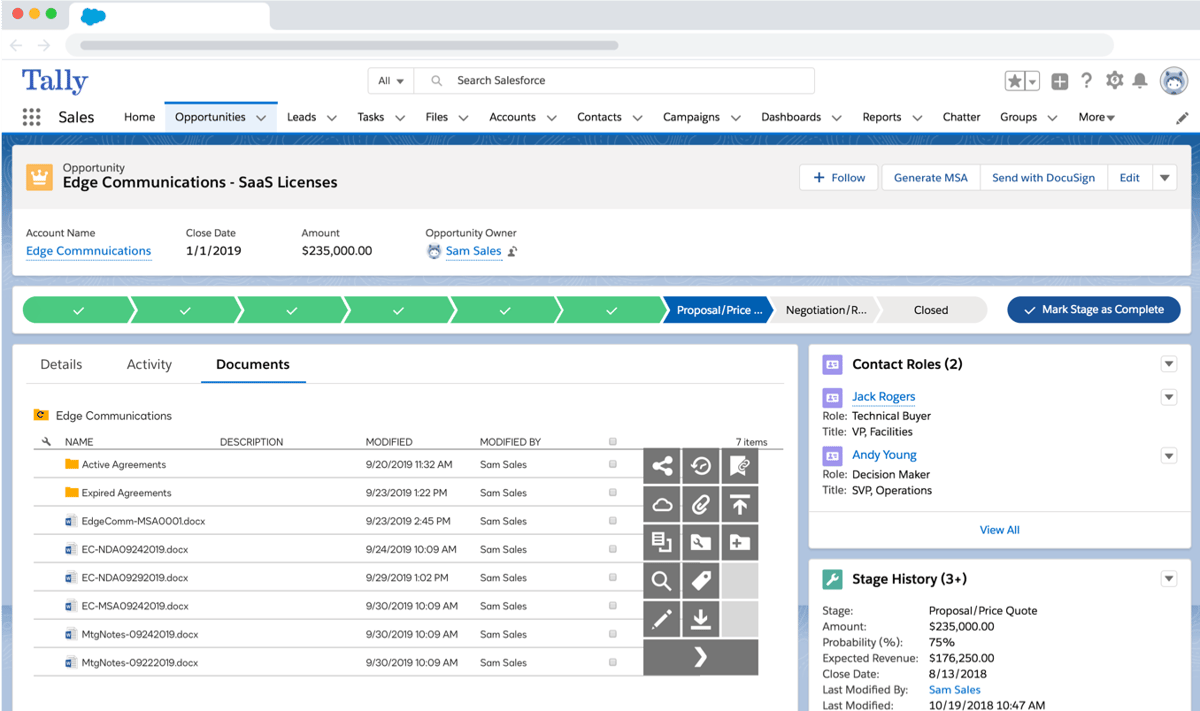
DocuSign CLM builds on the familiar e-signature tool many businesses already use. It adds structure to the entire contract lifecycle, which can make it easier to create, review, approve, and manage agreements at scale.

For teams that are already deep into DocuSign’s ecosystem, this upgrade keeps everything under one roof.

It’s designed for businesses that need more than just signatures. With tools like contract templates, workflow automation, and a searchable clause library, DocuSign CLM helps legal and procurement departments keep the workflow clean.

While it can be more rigid than newer platforms, it’s a solid pick for organizations with clear processes and established approval paths.

Best Features

  • Contract templates: Create and reuse contract formats with pre-approved language.
  • Automated workflows: Route contracts for review and approval based on team rules.
  • Clause library: Store common clauses and insert them as needed.
  • E-signature integration: Built-in access to DocuSign’s signature tools.
  • Audit trails: Keep full records of edits, reviews, and approvals.

Pros

  • Easy to add to an existing DocuSign setup
  • Strong workflow automation and approval tracking
  • Works well for larger companies with set contract processes

3. Agiloft

Best for: Legal operations, compliance, and procurement teams at mid-sized to enterprise organizations that require configurable workflows, detailed compliance controls, and tailored contract processes.
Agiloft

Source: G2

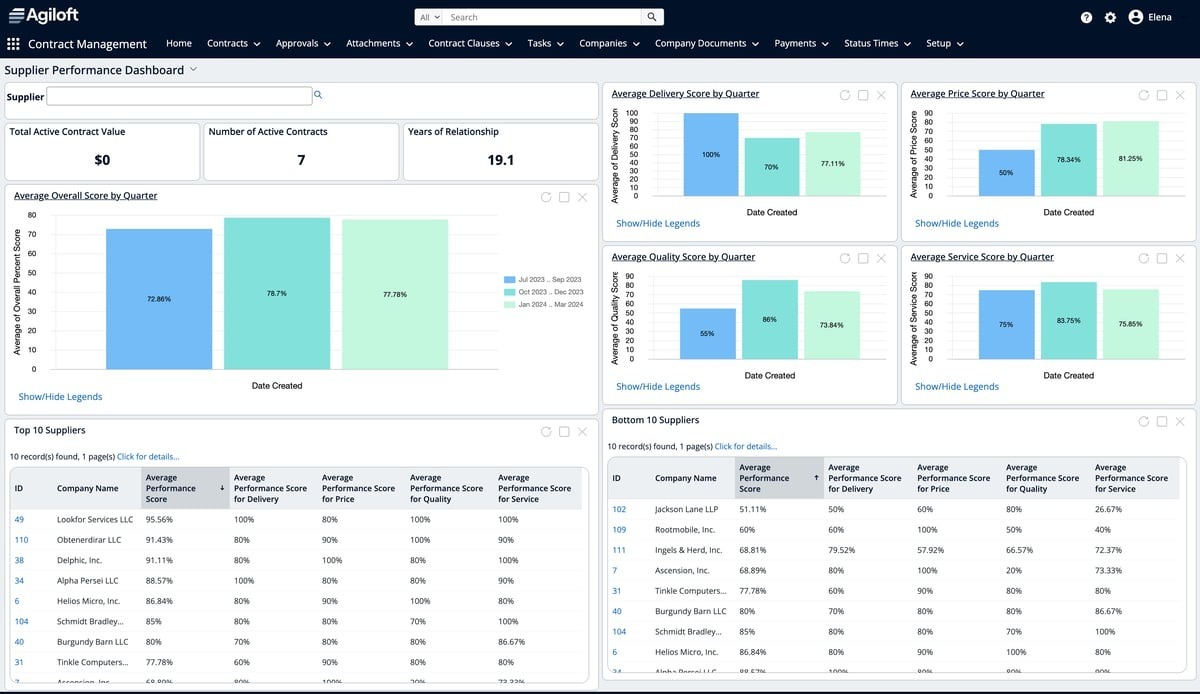
The Agiloft CLM platform is flexible contract lifecycle management software built for businesses that need full control over how they handle contracts.

It’s especially useful for legal, procurement, and operations departments that want to customize everything without needing developers. Its no-code setup gives users the freedom to build processes that match their team’s needs.

Agiloft also includes AI contract review features to speed up analysis, reduce compliance risks, and help users locate contracts quickly.

Best Features

  • No-code configuration: Customize fields, workflows, and dashboards without writing code.
  • AI contract review: Automatically analyze and flag risks, terms, or missing clauses.
  • Contract storage: Keep all your contracts in one secure, searchable place.
  • Contract visibility: Control who can access, edit, or approve documents across departments.
  • Contract requests: Create intake forms and contract approval flows to manage incoming contract needs.
  • Compliance tracking: Set alerts, reminders, and audit trails to reduce risk and stay on schedule.

Pros

  • Very flexible and easy to configure without IT
  • Strong AI tools for review and compliance
  • Suitable for users who need control over every step

4. Conga CLM

Best for: Revenue operations, sales operations, and legal teams at mid-market and enterprise companies that manage large volumes of sales agreements inside Salesforce.
Conga CLM

Source: G2

Conga CLM is contract management software that focuses on making business processes more predictable and efficient.

It’s built to help organizations reduce contract delays, improve accuracy, and keep teams aligned, especially those already using Salesforce. Conga lets users handle complex contract workflows without slowing down daily operations.

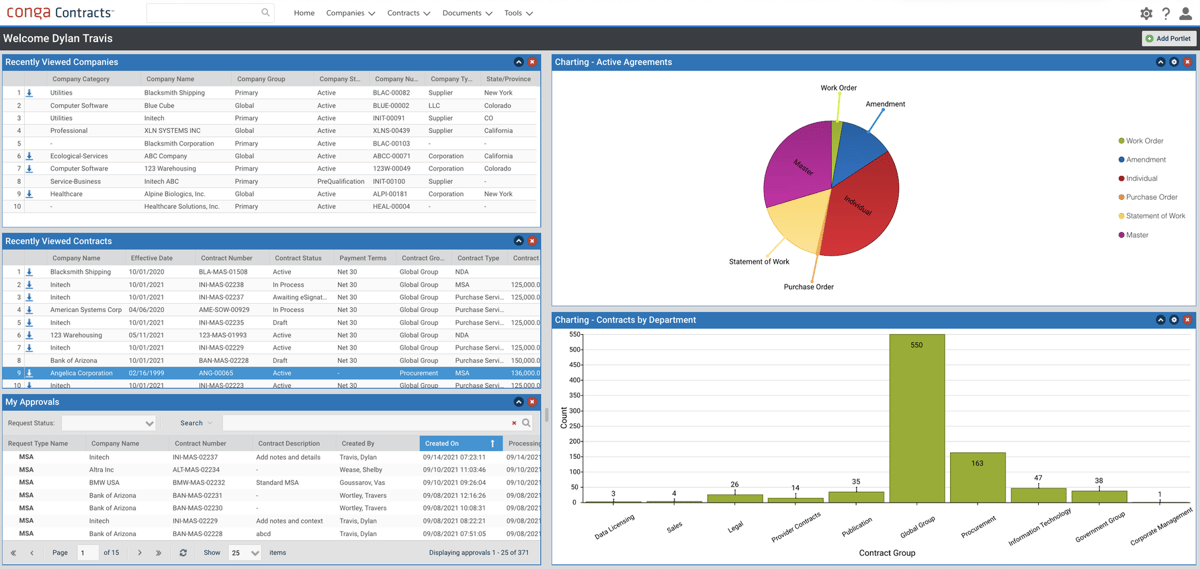
One thing that stands out about Conga is its contract analytics. Users can see how contracts move through the system, spot delays, and optimize contract performance using built-in reports.

Best Features

  • Salesforce integration: Built to work smoothly with Salesforce for sales-driven workflows.
  • Contract workflows: Automates routing, reviews, and approvals for faster turnaround.
  • Clause library: Use pre-approved language to cut down on review time.
  • Contract analytics: Monitor performance, identify bottlenecks, and improve processes.
  • Document generation: Pull in data from other systems to build contracts automatically.

Pros

  • Suitable for companies already using Salesforce
  • Helps standardize and speed up the contracting process
  • Useful analytics for improving contract performance over time

5. ContractSafe

Best for: Operations, finance, or legal teams at small businesses and growing companies that want an easy way to organize contracts without implementing a complex CLM system.

ContractSafe

Source: G2

ContractSafe is a contract management platform created for simplicity. It’s a suitable fit for businesses that don’t need a full-blown legal system but still want a secure and organized way to handle business documents.

If your team mainly needs to store, search, and track contracts without diving deep into complex contract creation or workflows, ContractSafe delivers just that.

It focuses on clean contract storage, smart search, and ease of use. The platform doesn’t overload users with features they won’t use. Instead, it’s about giving teams quick access to contract data and tools that reduce risk, minus the steep learning curve.

Best Features

  • Searchable contract database: Quickly locate contracts using keywords, filters, and tags.
  • Custom fields: Adapt the platform to match your unique business processes.
  • User interface: Clean, simple design that makes navigation easy for any organization.
  • Seamless integration: Works with tools like DocuSign, Salesforce, and Dropbox.
  • Reminders and alerts: Stay on top of deadlines, renewals, and contractual commitments.
  • Access controls: Manage who can view or edit specific agreements for better contract risk management.

Pros

  • Very easy to set up and use right away
  • Suitable for small to mid-sized companies managing business documents
  • Focused on contract data access without unnecessary complexity

6. Juro

Best for: Legal, sales, and operations teams at high-growth startups and scale-ups that manage high contract volumes and want cross-team collaboration in one platform.
Juro

Source: G2

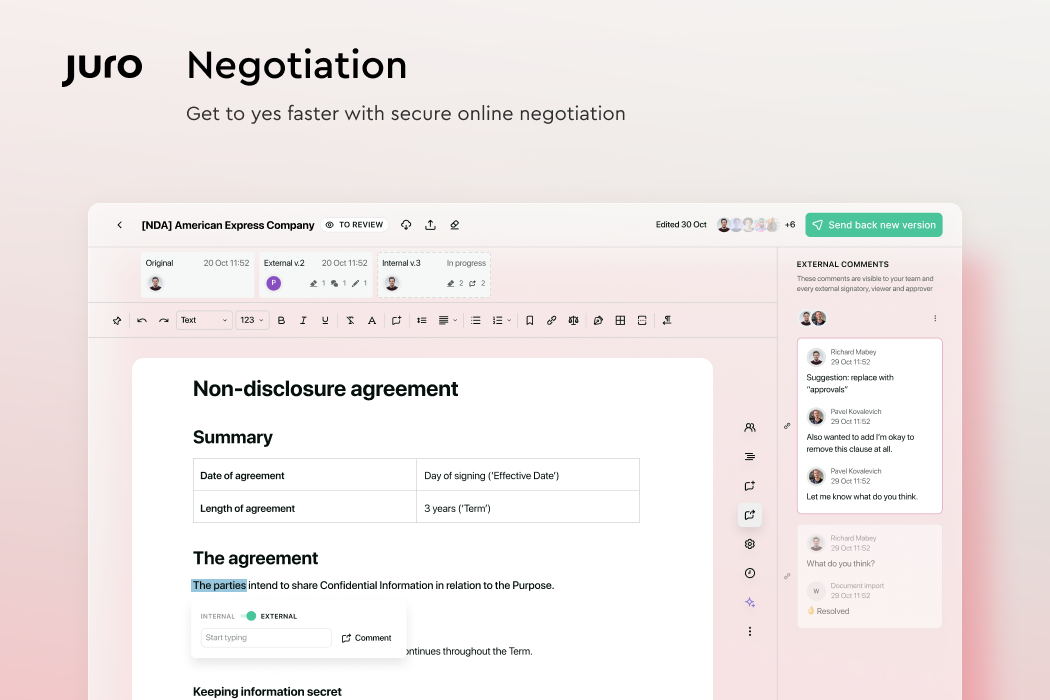
Juro is a contract management platform designed for companies that deal with high contract volumes and want to simplify the process from start to finish. Legal and business teams can collaborate in a shared workspace to avoid bouncing between tools.

Once you’re in, everything is neatly organized. Contracts, comments, approvals, and related documents live in the same place. Teams don’t have to dig through inboxes or shared drives; Juro keeps your contract portfolio searchable and structured.

It also connects with other business tools, so your contracts fit right into your existing systems.

Best Features

  • All-in-one workspace: Draft, review, approve, and sign contracts in a single browser-based platform.
  • Smart templates: Speed up contract creation with editable templates for common agreements.
  • Contract collaboration: Add comments, suggest edits, and tag teammates directly in the contract.
  • Integrations: Connects with tools like Salesforce, Slack, and Google Drive to improve flow.
  • Organized contract portfolio: Filter by contract type, stage, or owner to quickly find what you need.
  • Linked documents: Attach related documents so nothing important gets lost.

Pros

  • Clean interface that reduces friction between legal and business departments
  • Makes it easy to manage and search across a growing contract portfolio
  • Works well with other tools to support strategic decision making

7. ContractPodAi

Best for: Corporate legal departments at mid-market and enterprise organizations that need structured workflows, AI-assisted contract analysis, and centralized contract oversight.

ContractPodAi

Source: G2

ContractPodAi (now Leah) is an AI-first contract management solution that simplifies contract handling while maintaining structure and oversight. It combines contract automation, smart clause recognition, and clean workflows to reduce manual steps and improve the way contracts are handled.

The platform covers everything from new contract generation to managing legacy agreements, with tools that support fast execution and consistent compliance.

Missed deadlines and messy processes are less likely when everything lives in a single system, complete with reminders, version tracking, and approval routing that match how your team actually works.

Best Features

  • AI contract review: Scans contracts for key clauses, risky language, and missing terms.
  • Approval workflows: Routes documents through the right people at the right time.
  • Legacy contract management: Organizes older agreements so they’re searchable and report-ready.
  • Automation capabilities: Handles drafting, sending, and tracking with fewer manual inputs.
  • Workflow management: Keeps contract stages visible with task tracking and progress views.
  • User-friendly interface: Clean layout that makes it easy to stay focused and sorted.

Pros

  • Supports consistent execution with automated review and routing
  • Reduces chances of missed deadlines with smart tracking
  • Brings new and historical contracts under one roof

8. Concord

Best for: Legal, finance, and operations teams at small to mid-sized companies that want a simple contract platform with fast team adoption.
Concord

Source: G2

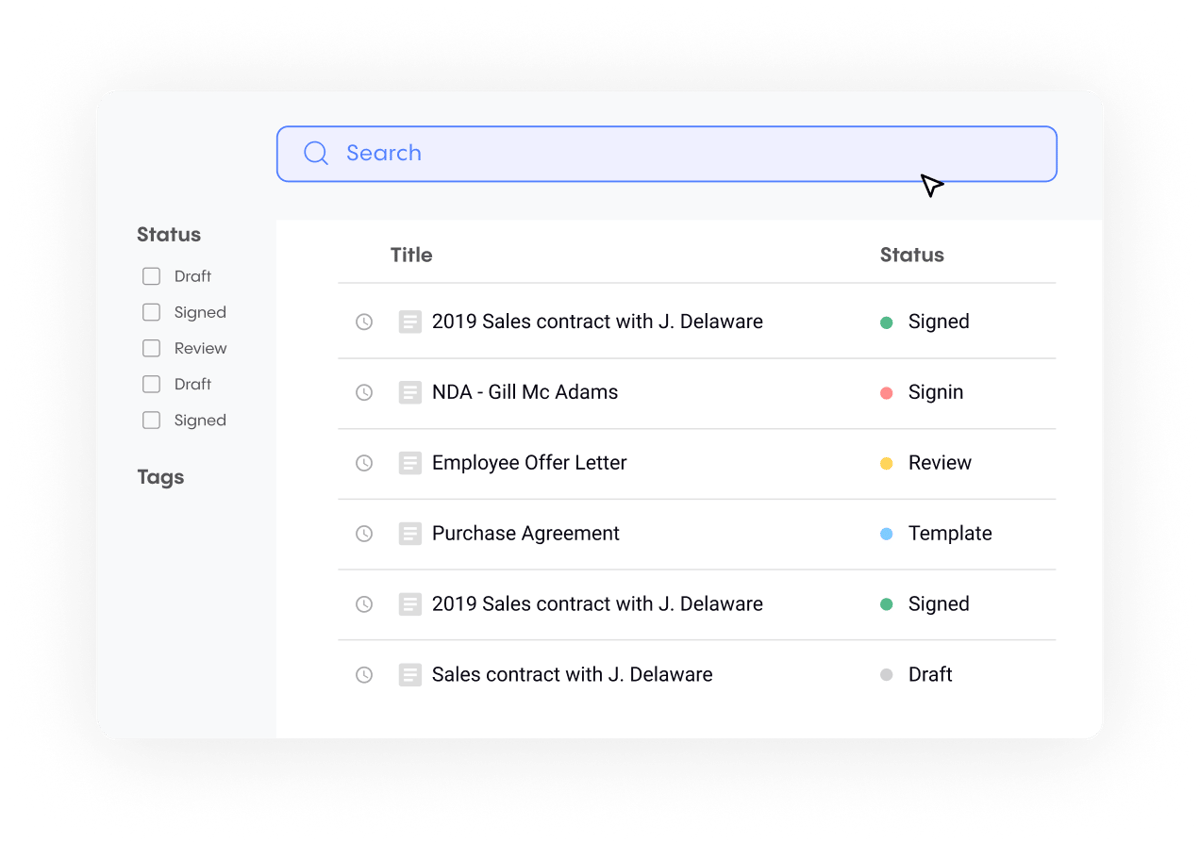
Concord is a cloud-based contract platform aimed at helping users stay on top of things while keeping the workflow simple.

It’s well-suited for mid-sized businesses that need to keep things moving. Concord covers everything from contract drafting and negotiation to signing and renewal tracking within a single interface.

Its clean layout and practical features encourage user adoption across departments. Teams can collaborate in real time, monitor contract status, and track renewal dates.

With automated approvals and audit-ready logs, Concord also supports risk mitigation and helps ensure compliance across your contract workflows.

Best Features

  • Collaborative editing: Make changes, leave comments, and manage versions in real time.
  • Automated approvals: Route contracts through the right reviewers to keep timelines on track.
  • Renewal reminders: Get notified before contracts expire to avoid missed renewals.
  • Audit trails: Maintain a full history of changes, users, and approvals for every document.
  • Templates and clause library: Speed up contract creation while maintaining consistency.
  • Reporting tools: Pull actionable insights from your contract activity and timelines.

Pros

  • Simple interface that supports fast user adoption
  • Helps teams meet deadlines and manage contract renewals
  • Reduces risk through built-in controls and approval flows

9. Coupa CLM

Best for: Procurement, sourcing, and finance teams at large enterprises that manage vendor contracts alongside purchasing and supplier performance inside the Coupa platform.
Coupa CLM

Source: Coupa.com

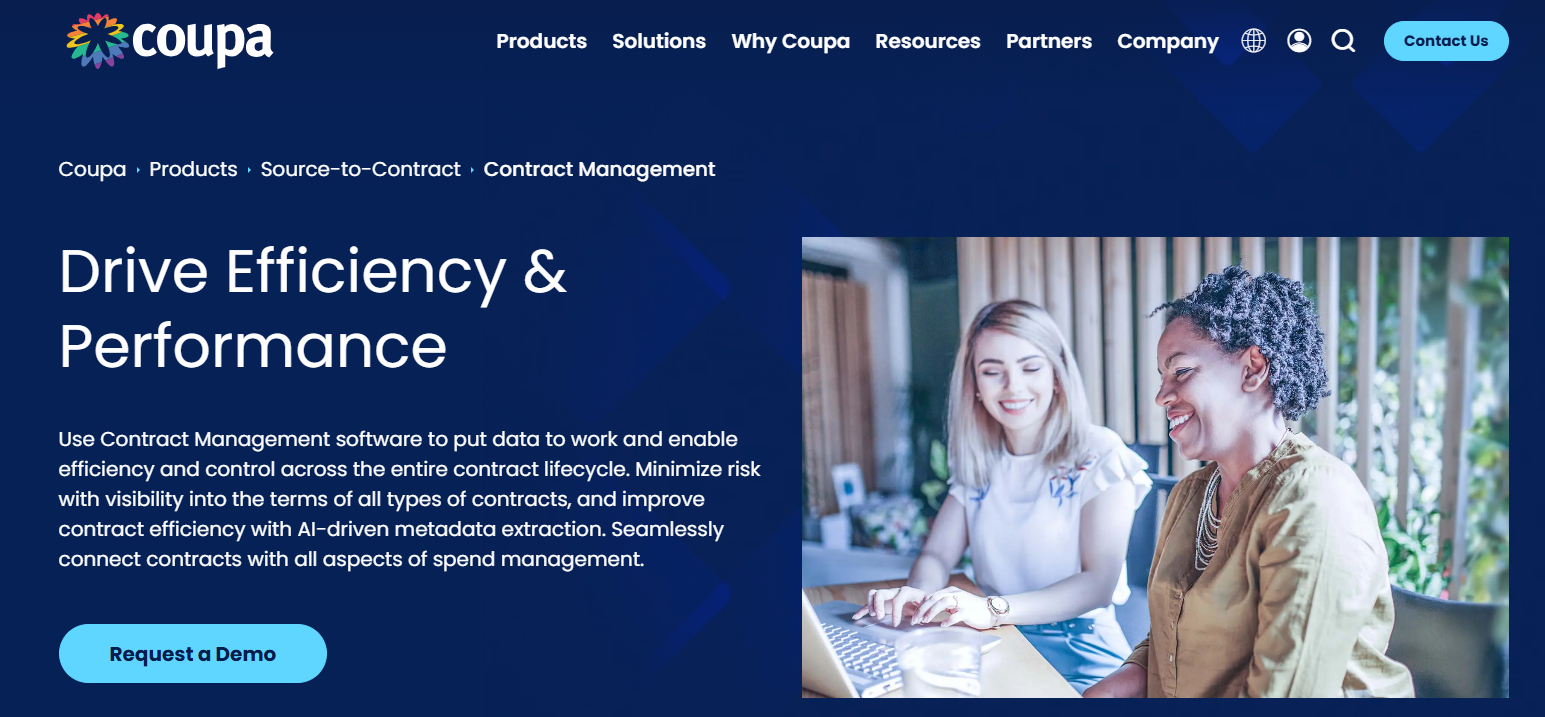
Coupa CLM is part of Coupa’s larger business spend management platform. This platform offers contract lifecycle tools with a strong focus on procurement, vendor relationships, and compliance. 

It’s a good fit for companies that want contracts to tie directly into financial planning and supplier performance.

Unlike more legal-focused systems, Coupa CLM brings contract workflows into the purchasing and sourcing process. Teams can manage contract terms alongside budgets, vendor data, and performance insights.

The result is better risk control, more timely approvals, and improved operational efficiency across sourcing and procurement.

Best Features

  • Procurement-focused workflows: Align contract terms with supplier and spend management.
  • Supplier performance insights: Monitor vendor delivery, pricing, and compliance issues.
  • Approval routing: Moves contracts through multi-level reviews based on business logic.
  • Integrated spend tracking: Connects contract data with budgets and forecasts.
  • Compliance controls: Flags contract terms that fall outside policy or increase risk.
  • Centralized contract repository: Stores contracts and related vendor documents for easy access.

Pros

  • Strong link between contracts and purchasing decisions
  • Useful for managing vendor compliance and spend
  • Supports timely approvals and better risk visibility

Why Teams Replace Their Contract Stack with Aline

Many Icertis alternatives improve one part of the contract workflow. Some focus on faster redlining, others offer better contract storage or workflow automation. While these tools solve individual problems, most still leave teams switching between multiple systems.

Aline takes a different approach.

Instead of adding another point solution to the stack, Aline replaces the entire contract workflow with a single AI-native platform. Drafting, redlining, approvals, signing, and contract analytics all happen in one system, eliminating the need to manage agreements across Word, email, e-signature tools like DocuSign, shared drives, and spreadsheets.

That consolidation is one reason teams see results quickly. Aline customers report 5–10× ROI within months, and the platform typically goes live in just a few days instead of months-long deployments. With 97% customer retention, many organizations continue to rely on Aline as their contract volume grows.

If your team is exploring Icertis alternatives because contract workflows are becoming harder to manage, simplifying the entire stack often makes the biggest difference.

Book a demo to see how Aline replaces your contract tool stack with one AI-powered platform.

Aline

FAQs About Icertis Competitors

Who are Icertis' competitors?

Common Icertis competitors include Aline, Agiloft, DocuSign CLM, ContractPodAi, Conga CLM, Juro, Concord, ContractSafe, and Coupa CLM. These platforms offer various tools for contract management, each catering to different team sizes, workflows, and budgets.

Is Coupa better than Icertis?

Coupa and Icertis serve different needs. Icertis focuses heavily on contract lifecycle workflows, while Coupa CLM is tied closely to spend and procurement processes. For companies managing vendor-related contracts and budget alignment, Coupa may feel more direct. But when looking at flexibility and cost effectiveness, alternatives like Aline may offer better value without added complexity.

How does the pricing structure of Icertis compare to other tools?

Icertis typically targets enterprise teams, and its pricing structure reflects that, often requiring long contracts and custom quotes. Hence, there is no public pricing available on their website. However, some teams might find that the pricing structure makes it less accessible. Tools like Aline offer transparent pricing with faster onboarding and fewer setup delays.

Is Icertis a unicorn?

Yes. Icertis reached unicorn status in 2019 and continues to operate as a major player in the CLM space. It’s widely used by enterprise teams that need contract management software designed for large agreement volumes, advanced controls, and structured compliance workflows.

Is Pramata better than Icertis?

Pramata works well for teams that want simpler contract visibility and risk management, while Icertis offers more complete control and a stronger workflow designer. The better choice depends on your process needs and the potential risks of picking a platform that’s either too heavy or too limited.


Draft, redline, and query legal documents 10X faster with AI

More Posts

You Might Also Like

No items found.

Want to learn more about Aline Workflows? Get in touch.

Learn more