Are contracts starting to slow down deals, approvals, or everyday work for your team?
If you’re comparing HyperStart and Juro, you’re probably looking for a contract platform that makes the process feel faster and easier to manage. HyperStart is known for speed and AI-driven workflows, while Juro focuses on collaborative drafting in a browser-based workspace.
Meanwhile, Aline brings a more complete CLM experience into the comparison, with AI, workflows, signing, reporting, and contract storage working together from the start.
In this guide, we’ll compare HyperStart, Juro, and Aline so you can see how each one handles contract work, where each tool fits, and which option gives your team the clearest path forward.
HyperStart CLM is AI-powered contract management software for teams that want a faster and cleaner way to handle contracts. It brings the entire contract process into one system to make sure that requests, reviews, approvals, signatures, storage, and tracking feel less scattered.
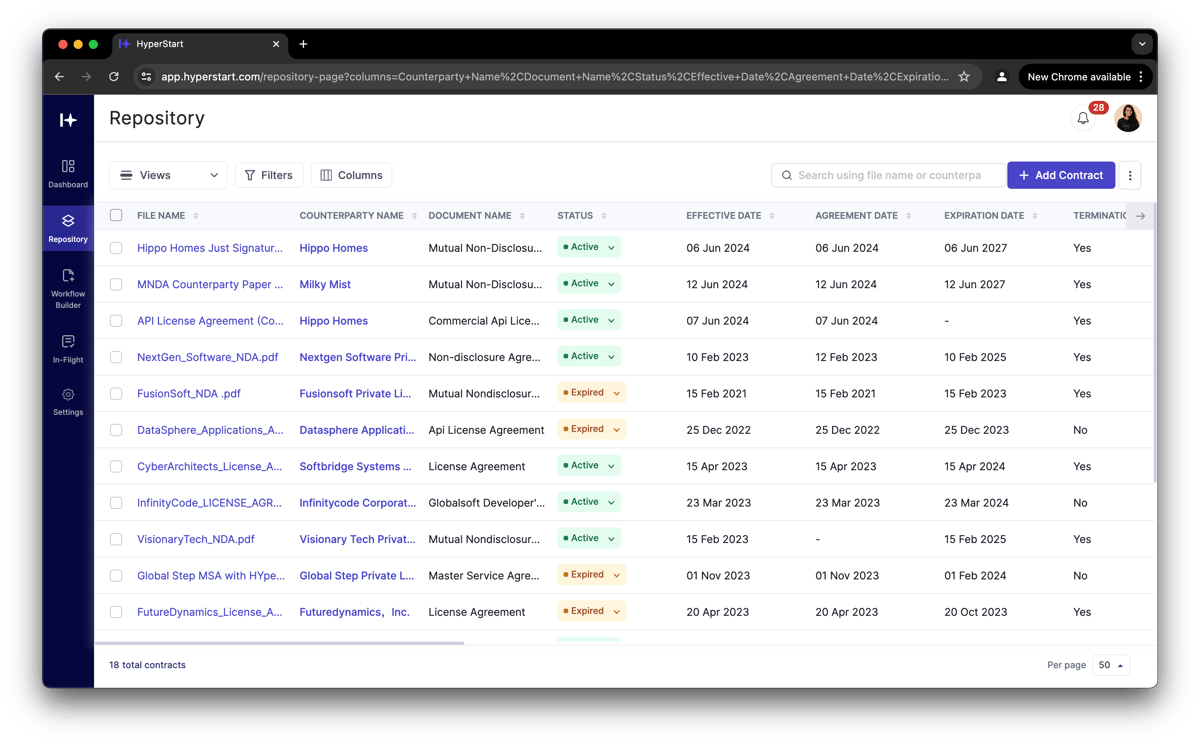
The platform is often used by legal teams, sales, finance, HR, and procurement teams that work with contracts regularly. Smaller teams may use it to build a more organized process early, while larger teams may use it to manage heavier contract volume with clearer workflows.
HyperStart is best known for its speed-focused approach. Its AI can help teams find contract details, pull key data, review language, and keep track of important dates. The workflow side also helps contracts move from one stage to the next with fewer manual follow-ups.
Overall, HyperStart has a modern, practical feel. It fits teams that want CLM software with AI, contract automation, and contract visibility built into everyday work.
Juro is a contract lifecycle management platform centered on collaborative contract drafting. Its biggest draw is the in-browser editor, which lets teams create, review, negotiate, sign, and manage contracts without moving the document through several different tools.
A lot of teams use Juro for routine agreements like NDAs, MSAs, order forms, employment documents, and vendor contracts.
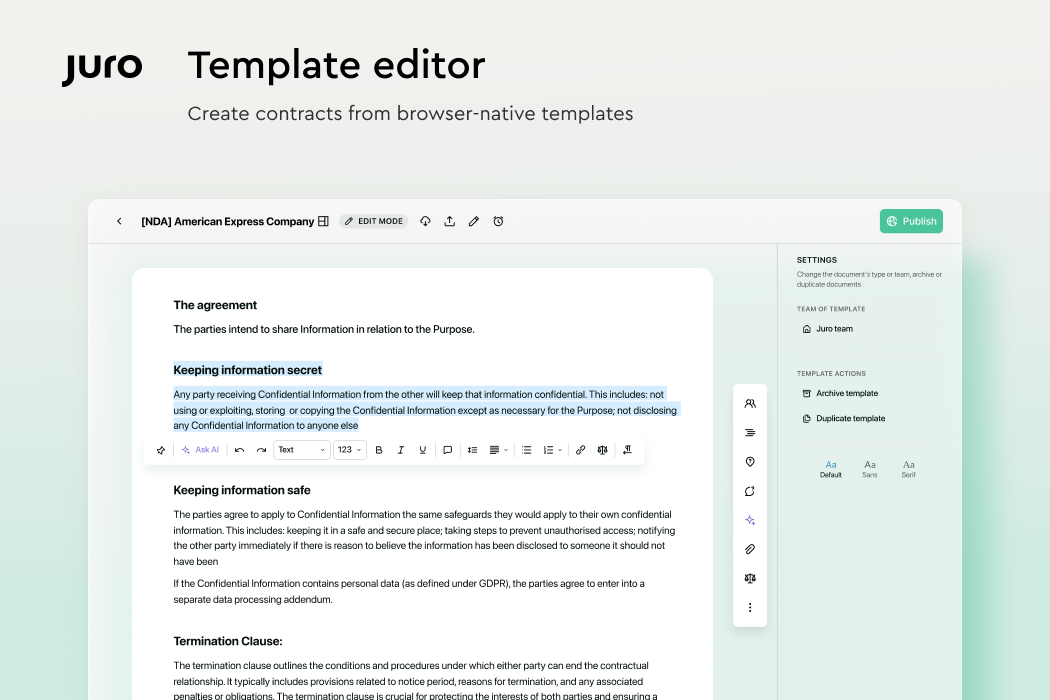
Legal teams can set up approved templates and rules, while sales, HR, finance, and other departments can generate contracts on their own without starting from scratch each time.
Juro has a lighter, more collaborative feel than many traditional CLM platforms. Comments, edits, approvals, signing, and contract tracking all sit close to the document itself, which can make the process feel easier for teams that spend a lot of time creating and negotiating contracts.
Aline is an AI-powered contract lifecycle management platform built to help you manage the full contract lifecycle in one place.
With it, you can create contracts, review terms, route approvals, collect signatures, store agreements, and track contract data without piecing together separate processes.
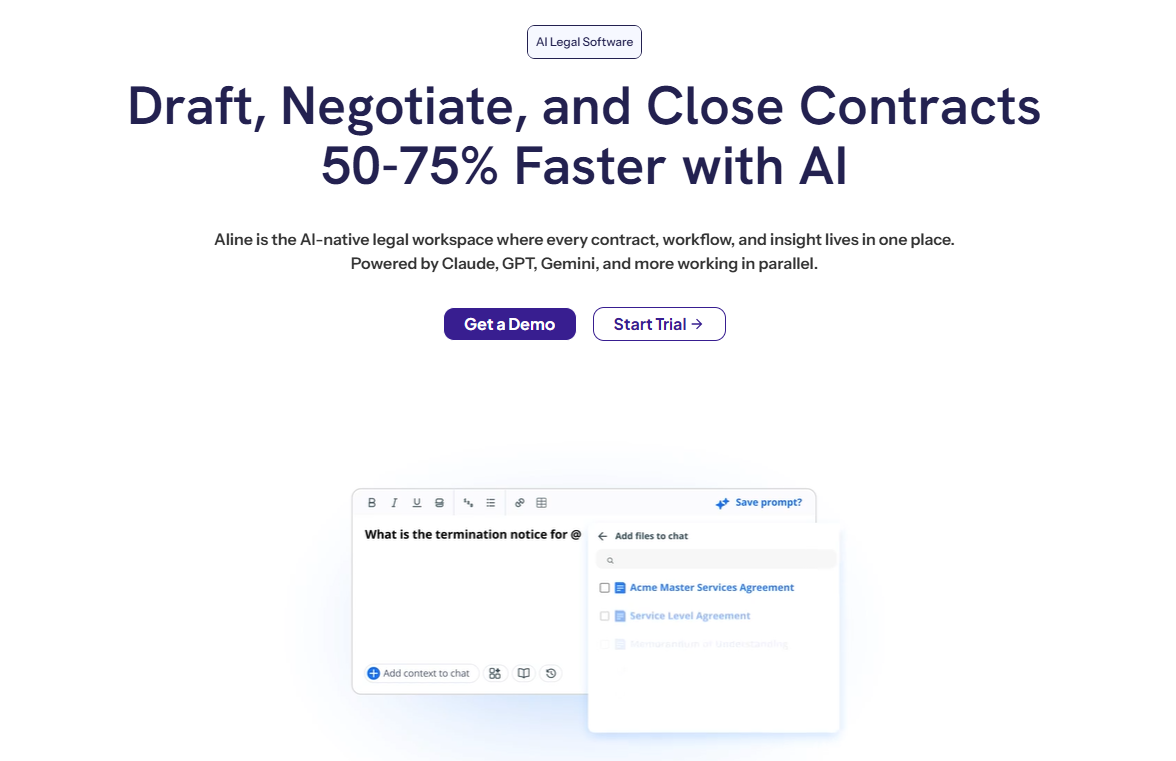
If you handle different contract types, Aline gives your contract work a clearer path from the start. You can begin with approved templates, use legal AI for contract creation and redlining, then move documents through built-in workflows so reviews and approvals stay organized.
From there, Aline also gives you AlineSign for e-signatures, an AI contract repository for searchable storage, and reporting tools that help you see key dates, terms, and contract activity.
What makes Aline stand out is how connected the entire process feels. Every stage has a place, and AI support fits into the parts of contract work that usually take the most time.
Book a demo to explore Aline’s features in more detail.
Choosing between HyperStart, Juro, and Aline depends on how your team handles contracts today and what you want your CLM platform to improve first. To make the comparison easier, let’s look at the main factors that usually influence the decision.
HyperStart, Juro, and Aline are all CLM platforms, but each approaches contract management differently.
HyperStart puts speed and automation front and center. In practice, the platform helps teams bring contract requests, approvals, signatures, storage, and tracking into a faster CLM process.
Plus, its AI-driven contract management features support search, contract data extraction, and workflow visibility.
Juro, on the other hand, focuses heavily on contract drafting and collaboration. Its browser-based editor gives teams a shared workspace to create, edit, negotiate, approve, and sign contracts.
As a result, teams that prepare and negotiate routine agreements often find Juro’s document-first setup useful.
Aline takes a broader approach to the full contract lifecycle. Along with AI, workflows, electronic signatures, document management, reporting, and a central repository, the platform connects every contract step in one connected and trackable system.
Among the three, Aline gives the most complete path from contract creation to post-signature management.
Features can easily make or break your CLM choice, especially if your team wants fewer manual steps and better visibility. Here’s how HyperStart, Juro, and Aline compare feature by feature.
HyperStart is generally a good fit for fast-growing companies, mid-market teams, and legal departments that want a quicker way to organize contract work. It can also work well for sales teams, finance teams, HR, and procurement teams that need contract visibility without the complexity of traditional CLM systems.
Juro, meanwhile, is often a strong choice for business teams that create and negotiate routine agreements frequently.
Its browser-native editor can be useful for non-legal users and business users who need to generate contracts from approved templates, while in-house legal teams keep control over terms, approvals, and contract standards.
Aline is best for teams that want a more complete CLM tool for the full contract lifecycle.
In particular, it works well for in-house legal teams, sales teams, finance teams, operations teams, and other departments that need multiple users to create, review, approve, sign, store, and report on contracts in a connected system.
For large enterprises, Aline can support more structured workflows, contract visibility, and reporting needs. At the same time, its no-code setup helps teams avoid the steep learning curve and extensive training that often come with older contract management platforms.
CLM pricing usually depends on how your team plans to use the platform, from the number of users to AI features, integrations, and workflow needs. Here’s how HyperStart, Juro, and Aline compare on pricing:
HyperStart does not show public plan prices on its main pricing path, so teams usually need to book a demo or speak with sales for a quote.
Juro builds custom pricing based on contract volume, AI features, integrations, and workflow complexity, among other factors.
Aline offers a free trial option, so you can explore the platform before committing.
Check out Aline’s pricing plans to see which option fits your team’s contract volume, workflows, and AI needs.
HyperStart and Juro solve different parts of the CLM experience well. HyperStart leans into speed and automation, while Juro makes collaborative contract drafting feel more approachable.
Aline, however, gives teams a more complete way to manage the contract lifecycle without making the process feel heavier than it needs to be.
If you want to streamline contract management, Aline brings AI-powered support, workflows, signing, storage, and reporting into one connected experience.

For scaling companies with complex workflows, Aline gives legal, sales, finance, and operations teams a shared system that keeps the entire contract lifecycle easier to manage from start to finish.
Contract management should feel easier to run as your team grows. Start your free trial today.
Juro may feel easier for business teams that spend a lot of time drafting and negotiating routine contracts because its browser-based editor keeps contract work close to the document. HyperStart also supports non-legal teams, especially when speed, workflow automation, and contract visibility are the main priorities.
Both can support legal teams, but the better fit depends on how the team works. HyperStart may appeal to teams that want AI-assisted contract operations and faster setup, while Juro may suit teams that want a collaborative workspace for contract drafting, approvals, and negotiation.
Both platforms offer integrations, though the exact setup can vary based on your tech stack and plan. Teams should review CRM, storage, e-signature, and Microsoft Word integration needs early so they can understand the configuration effort before rollout.
Aline is a strong choice if your team wants a broader CLM platform for contract creation, approvals, signing, storage, and reporting. It can support legal while also enabling sales reps and other business users to create and review contracts through guided workflows and approved templates.